
Clínica Be Dharma | Torre Médica Oviedo, Medellín
Robotic hair transplant in Medellín
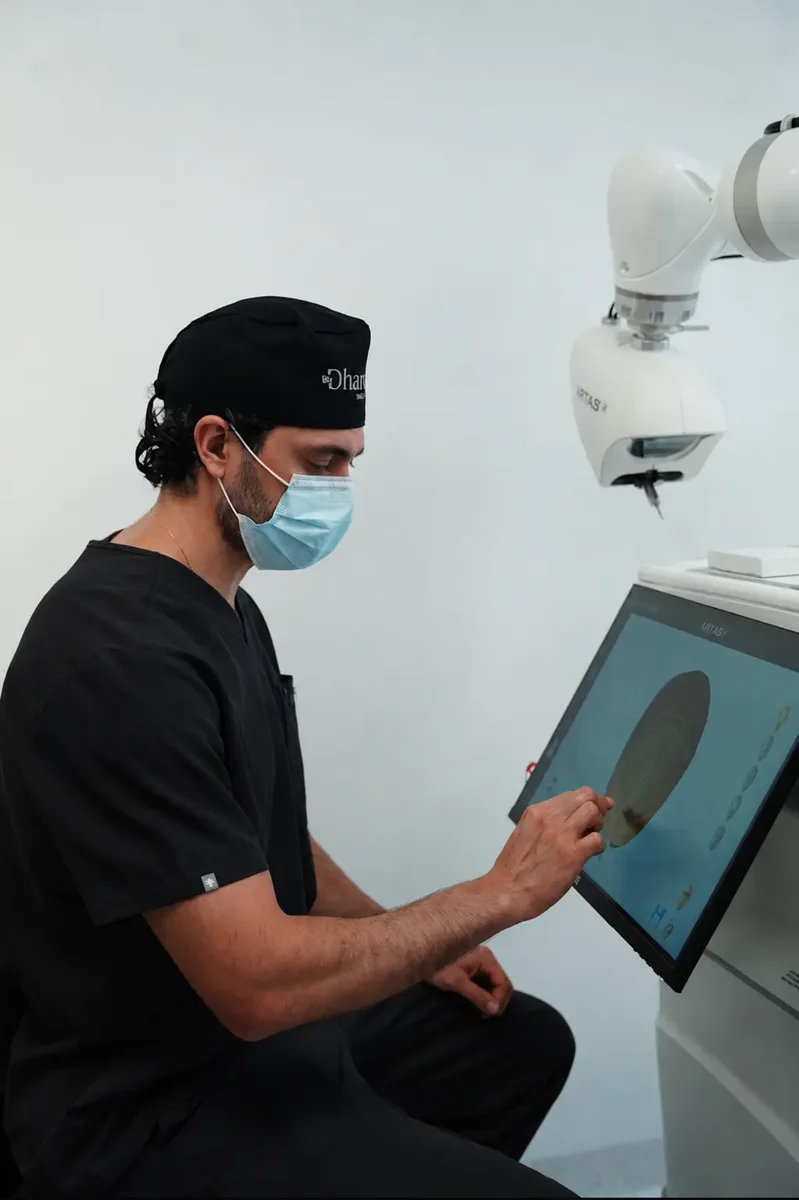
Restore your hairline or your crown with your own hair. The ARTAS iX robot harvests each follicle using cameras and mechanical precision, as exact on the last one as on the first, while your doctor designs the hairline around your own face.
We stay with you from the consultation through the months it takes to see your result.
Confidence at every stage
The robot's precision and the doctor's judgment, at every stage
-
Camera vision
It reads the position, angle and direction of each follicle before harvesting it.
-
Harvesting spread out
It works grid by grid so no single area of the donor zone is emptied.
-
The doctor checks
The first units are examined before harvesting continues.
-
Torre Médica Oviedo
Floor 7, El Poblado, Medellín. In-person consultation, or by photos on WhatsApp.
What it is
A robotic hair transplant is an FUE procedure in which the ARTAS iX robot does the harvesting: it locates each follicular unit with cameras, calculates its angle and extracts it with a mechanically guided punch.
It is not a different technique from FUE: it is another way of doing its longest, most repetitive step. A transplant means harvesting hundreds or thousands of units, and the robot holds the same precision on the first and on the last, without the fatigue of the hand.
The doctor stays in charge: he designs your hairline, checks the grafts and decides where they go. If manual technique suits your case better, we say so at the consultation and move to the manual FUE hair transplant.
2026 pricing
How much does a robotic hair transplant cost in Medellín?
COP 25,000,000 for maximum harvesting: up to 3,000 follicular units in one session, the ceiling our doctors consider safe for your donor area.
2026 prices · the figure covers the whole procedure · the difference from manual FUE corresponds to the robotic technology. Prices for the manual technique, from 1,500 to 3,000 units, are on the FUE hair transplant page.
Robot and doctor
What the robot does and what the doctor decides
The question we get most is whether the transplant “is done by a machine”. It is not: the robot performs the harvesting and the doctor directs everything else. The US FDA defines it the same way, classifying the ARTAS system as equipment that assists the surgeon in identifying and harvesting follicles.
Design your hairline · decide how many units you can donate · judge what is happening under the skin · control whether each graft takes
- 01Hairline design · doctor
He sets the shape, the height and the density according to your face and your age.
- 02Donor area mapping · robot and doctor
The cameras read each follicle; the doctor sets how much can be harvested.
- 03Harvesting · robot
Grid by grid, with repeatable movements. If it loses sight of the follicle, it does not harvest.
- 04Quality control · doctor
He checks the first units before continuing and picks the single-hair ones for the hairline.
- 05Implantation · doctor
He sets the angle and direction of each graft. The robot can help create the sites, depending on the protocol.
The robot does not change our limit. Harvesting faster does not mean harvesting more: the donor area does not grow back, and every follicle taken out will not grow there again. That is why we do not go beyond 3,000 units in one procedure with the ARTAS iX either. If your case needs more, it is planned in stages.
Robot or manual FUE? Which suits your case
Both are FUE techniques and reach comparable results in quality and naturalness. What changes is who does the harvesting, and the choice depends on your hair and your donor area:
Dark hair and a wide donor area
The robot makes good use of the contrast between hair and skin, and spreads the harvesting across the whole donor zone.
Grey or very light hair
The system recognises hair by contrast: it may need special preparation, or manual FUE is considered instead.
You would rather not trim the donor area
The robot needs the hair very short where it works. If that matters to you, we discuss it at the consultation.
Curly hair or small areas
The technique is decided case by case, after looking at how the follicle grows under the skin.
If manual technique is the right one at the consultation, we say so: the technique follows your case, not the other way round. See the manual FUE hair transplant.
What a session with the ARTAS iX robot is like
You are awake the whole time, under local anaesthetic, and you can talk with the team. It takes several hours, with breaks:
1. Preparation
The hair in the donor area is trimmed very short so the cameras can read it, and local anaesthetic is applied.
2. Grid and harvesting
A small grid is placed on the skin. The robot reads each follicle inside it, harvests it and moves to the next area, spreading the harvesting out.
3. Medical check
Dr. Andrés Arango checks the first units before continuing, and the nursing team counts and sorts them throughout the session.
4. Implantation and discharge
The grafts are placed following the design you approved. You go home the same day, with your instructions and your follow-up appointment.
Recovery
What recovery from a robotic transplant is like
It is the same as any FUE: the robot changes the harvesting, not the way hair takes and grows.
- Days 1–5Swelling and tightness
You sleep with your head raised and avoid touching the implanted area.
- Days 7–14The donor area closes
The tiny harvesting points heal and the scabs come off.
- Weeks 3–4Expected shedding
Much of the implanted hair sheds; the root stays and grows back.
- Months 3–4First regrowth
The new hairs appear, fine at first.
- Months 6–9Density builds
The hair thickens and the difference becomes visible.
- Month 12Final result
With thick or curly hair it can take a little longer.
The donor zone is left with small dot-like marks spread out, which are usually not noticeable once the hair grows. The aftercare for each stage is on the FUE hair transplant page.
Risks and limits of the robotic transplant
It is minor surgery, with the risks of any FUE. The robot makes the harvesting more precise, but it does not remove them.
forehead swelling · scabs and itching · mild discomfort in the donor area · temporary shedding of the implanted hair
pimples or folliculitis · infection · small cysts · numbness lasting months · white dots visible with very short hair
it cannot control whether each graft takes · it does not stop the loss of hair that is not transplanted · not every hair type is a candidate
Smoking, diabetes, blood thinners and harvesting more than 3,000 units all add risk. Tell us at the consultation: that is what decides the technique and the plan to keep the hair you still have.
Medical Director

Dr. David Delgado
Plastic Surgeon
Medical experience at your service
Physician and surgeon from the Universidad Industrial de Santander, and Maxillofacial and Hand Plastic Surgeon from the Universidad de Antioquia. More than 15 years of experience.
Hair transplant doctor

Dr. Andrés Arango
Hair transplant doctor
Who performs your transplant
Dr. Andrés Arango Dr. Andrés Arango performs the robotic hair transplant at Be Dharma, from the consultation through the follow-ups. He works with a nursing team that operates the ARTAS iX robot and handles counting and sorting the follicles.
The ARTAS iX robot at Clínica Be Dharma
ARTAS iX is the current generation of the ARTAS robotic hair restoration system, first cleared by the US FDA in 2011 for harvesting follicular units. It combines a robotic arm, camera vision and algorithms that identify each follicle before harvesting it.
We use it at Torre Médica Oviedo, in El Poblado, with the same team that performs manual FUE. That way the choice between the two techniques depends on your case and not on what happens to be available.
Book your consultation
Tell us which area you want to restore and we will contact you for your hair consultation. If you prefer, send us your photos on WhatsApp.
Have questions?
Frequently asked questions about robotic hair transplants
Does the robot do the transplant on its own?
No. The ARTAS iX robot mainly handles harvesting the follicles; the doctor designs the hairline, checks the grafts, supervises the session and decides the implantation.
How much does a robotic hair transplant cost in Medellín?
COP 25,000,000 in 2026, all inclusive, for maximum harvesting of up to 3,000 follicular units. That is more than manual FUE with the same number of units (COP 15,000,000) because it adds the robotic technology. For fewer units, the price is quoted at the consultation.
Is a robotic hair transplant better than a manual one?
Not in every case: results are comparable in quality and naturalness. The robot brings consistent precision to the harvesting, and the manual technique adapts better to some hair types. The choice is made at the consultation.
Does a robotic hair transplant hurt?
It does not hurt during the procedure, because it is done under local anaesthetic: you feel the initial injections and then pressure. Afterwards there can be mild discomfort for a few days.
Do you have to shave your head for a robotic transplant?
The donor area, where the robot works, has to be trimmed very short. How much is trimmed depends on the number of follicles and is settled at the consultation.
Does it work with grey or curly hair?
With grey or very light hair the robot may need special preparation, because it recognises hair by contrast. With curly hair, the technique is decided at the consultation, after looking at how the follicle grows under the skin.
Is a robotic transplant suitable for women?
Yes, when the loss is localised and the donor area is good. In women, how much of the donor area to trim is looked at with particular care.
How long does the result last?
Implanted hair usually keeps long term, because it comes from an area resistant to balding, although over the years it can thin like the rest of the hair. Native hair can keep falling; that is why it is paired with a maintenance treatment.