
Filling
Small or moderate damage
- How much tooth is removed
- Only the damaged part
- Where it is made
- In the mouth, same visit
- Material
- Composite resin
- Visits
- One
Composite resin repairs decay and small fractures with a material the color of your own tooth. It is shaped and polished until the repair blends into the rest of the enamel.
An X-ray shows how far the damage actually reaches: that decides whether a filling is enough or another option is needed.
We take the shade from the neighboring tooth and layer the composite to reproduce its translucency, not a flat white.
Old amalgams and stained composites can be swapped for tooth-colored material.
We work inside a medical building with imaging equipment and sterilization on site.
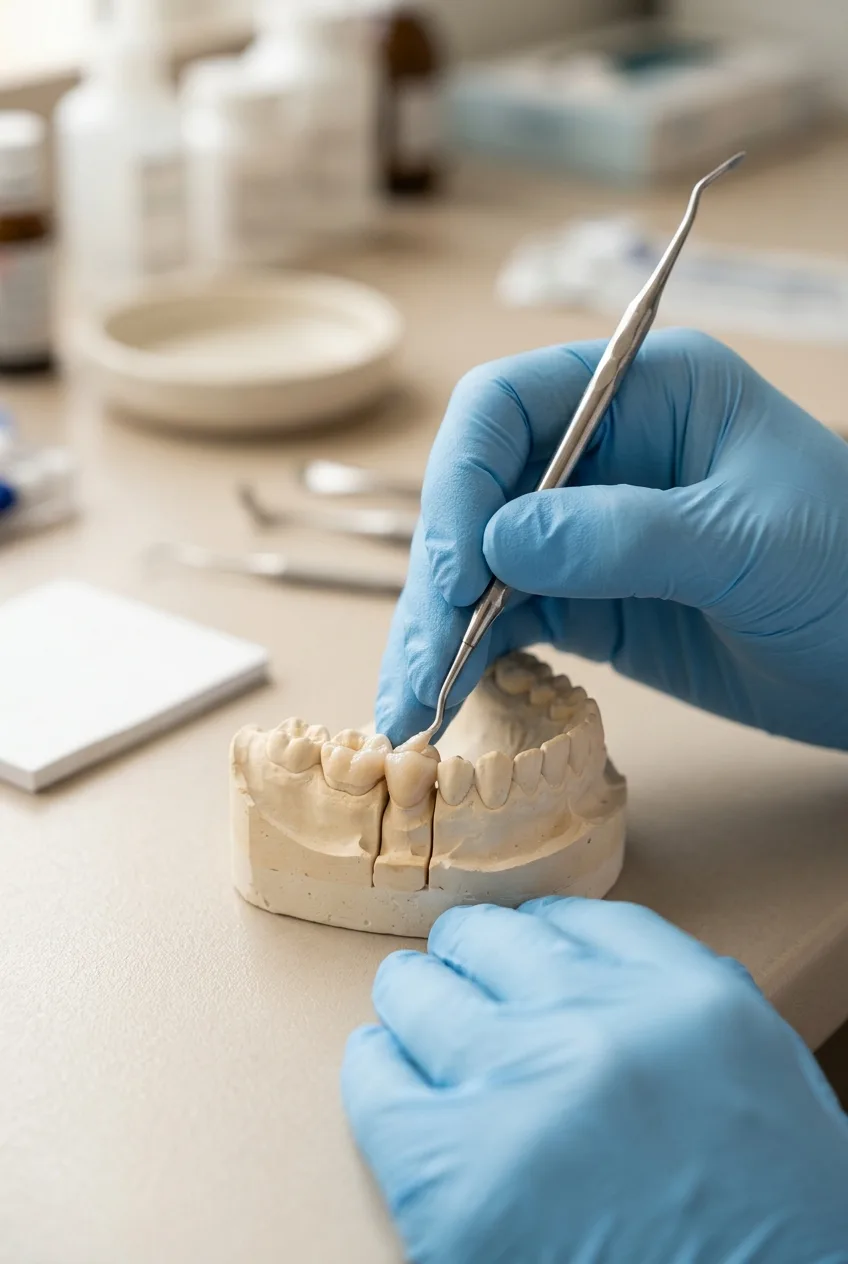
A composite filling is indicated when a tooth has to be repaired without sacrificing the healthy part, and when it matters that the repair does not show. What it aims for: to restore the shape of the tooth, make chewing on that side comfortable again and have the repair blend with the enamel. The final indication depends on the X-ray. It is usually considered in cases like these:
Composite bonds to the tooth and replaces only the damaged part, so it preserves as much natural structure as possible. That is why it is the first option when the damage is small or moderate.
When decay has left little healthy tooth, or the tooth has had a root canal, composite will not take the bite force and the indication becomes an inlay or a crown. That is decided with the X-ray in front of us.
We check how far the decay reaches. A lesion that looks small on the surface can be wide underneath, and that changes the indication.
The shade is taken with the tooth hydrated and in natural light, comparing against the neighboring teeth. This step is what makes the filling go unnoticed.
The area is numbed and only the affected tissue is removed, keeping as much healthy tooth as possible.
The tooth is conditioned, the adhesive is applied and the composite is placed in layers cured with light, reproducing the shape and translucency of the tooth.
We check that the tooth meets the opposing one correctly and polish it to an enamel shine. An unpolished filling stains sooner.
When a tooth has to be repaired, the difference between a filling, an inlay and a crown comes down to how much healthy tooth is left and how much bite force that area has to take.
Small or moderate damage
Extensive damage, walls still sound
Little tooth left, or a root canal was done
A filling has no single price: it depends on how many surfaces of the tooth have to be rebuilt and on whether it is a front tooth or a molar. The figure is confirmed at the consultation, with the X-ray in front of us.
At the consultation we tell you which teeth should be treated first and which ones can wait.

General dentist · Lic. 5-4513-08
View profile
Periodontist
View profile
Medical director
View profileIt depends on where it is, how much force it takes when you bite and on your hygiene. A filling on a front tooth usually lasts longer than one on a molar carrying the whole chewing load. It is not a permanent material: over the years it can stain at the margins or wear down, and then it is replaced.
The procedure is done under local anesthesia. Afterwards you may feel cold sensitivity for a few days, especially if the decay was deep.
The aim is that it does not. The result depends on the shade chosen, the composite layering and the final polish. On very translucent or heavily stained teeth, matching the color takes more work and is worth discussing beforehand.
If little healthy tooth is left, a large filling can fracture under bite force: in those cases an inlay or a crown is indicated. There may be temporary cold sensitivity. Composites stain with coffee, red wine and tobacco. And if the decay has reached the nerve, the nerve has to be treated first: filling over it only delays the problem.
Yes, and it is a common reason for consultation. Each tooth is assessed on its own: if the amalgam is sound and the tooth healthy, the change is cosmetic; if there is leakage or decay underneath, it is also clinical.
A simple filling takes under an hour. Several teeth or a cosmetic rebuild of front teeth take longer and are sometimes split into two visits.
You can eat the same day, carefully for the first few hours. After that: brushing, floss and regular check-ups. Cutting back on coffee, red wine and tobacco keeps the color longer.
We tell you which teeth are worth repairing, in what order, and how far composite can take you.
Torre Médica Oviedo · Calle 6 Sur #43A-227, floor 7, suite 776 · El Poblado, Medellín. Monday to Friday 8:00–17:00 and Saturday 8:00–12:00.
Aesthetic Clinic I Website and strategy by: amedik.co
All rights reserved I 2022
WhatsApp us