
Fotona for Scars: What It Can Improve
Scars can change the texture, the relief and the evenness of your skin long after the injury or the acne itself has gone. When those marks bother you, or the surface of the skin stops being uniform, laser resurfacing is one of the options worth assessing.
What follows is written to be specific about what this treatment can improve and what it cannot, because with scarring the difference matters more than with almost anything else in aesthetic medicine.
Fotona for Scars: How It Improves the Appearance of the Skin
The Fotona laser for scars can improve the texture and relief of certain marks through controlled renewal of the skin. The protocol is adjusted to the type of scar — which is why the assessment comes before any promise about the result.
It improves skin texture
Resurfacing with Fotona can produce a more even surface by working on the irregularities and texture changes associated with certain scars.
It softens depressed scars
In some atrophic scars, such as those left by acne, the treatment can visually reduce differences in depth and relief.
It renews the skin surface
Fotona’s Er:YAG technology allows a controlled renewal of the superficial layers of the skin, gradually producing a more even appearance.
It supports tissue remodelling
The treatment aims to stimulate the natural repair and collagen remodelling processes that can gradually improve how a scar looks.
It makes the skin more uniform
By working on texture and relief, the treatment can make the transition between the scar and the surrounding skin visually less marked.
How Does the Fotona Laser Work on Scars?
The Fotona laser for scars uses controlled energy at different levels of the skin to support tissue renewal and gradually improve irregularities in texture and relief. The protocol is adjusted to the type of scar, its depth and the characteristics of your skin.
1. Assessing the scar
Before starting, we look at the type of scar, its depth, its location and the characteristics of your skin, in order to define the protocol that fits your case.
2. Controlled laser energy
Fotona delivers laser energy precisely over the treated area. The intensity and depth are adjusted to what the scar needs and to the goal of the procedure.
3. Renewing the skin surface
In resurfacing protocols, the Er:YAG laser acts on the superficial layers through controlled ablation, supporting gradual renewal of the tissue.
4. Remodelling and better texture
During recovery the skin goes through a phase of repair and remodelling that can soften irregularities and gradually improve how the scar looks.
What Is Laser Resurfacing for Scars?
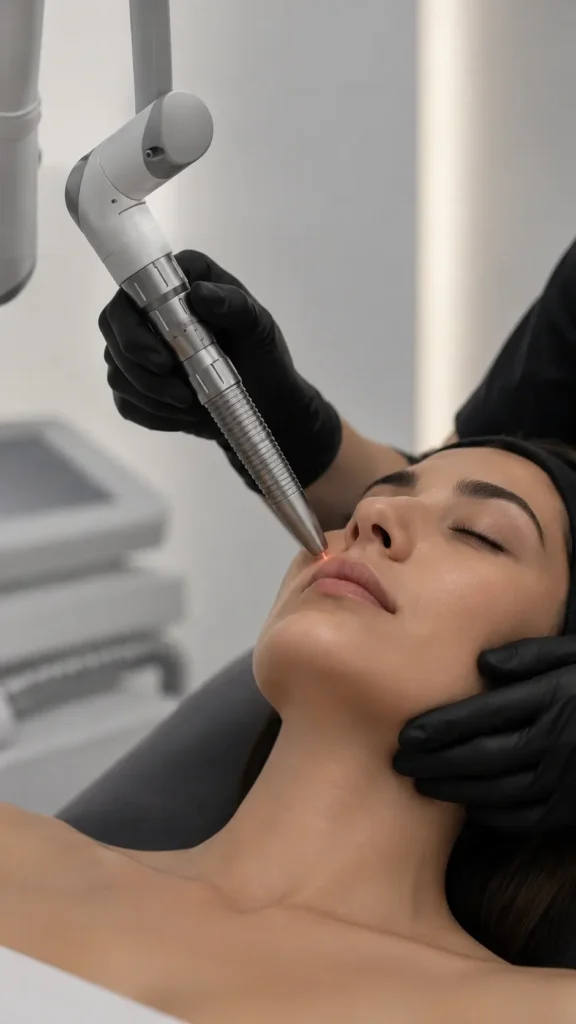
Laser resurfacing for scars is a skin renewal technique that uses laser energy in a controlled way to work on irregularities in the surface of the skin and support gradual repair and remodelling.
- Controlled skin renewal: the treatment acts on the superficial layers to work on irregular tissue and support gradual renewal of the treated area.
- Precise action with Er:YAG laser: with an ablative laser such as Er:YAG, microscopic layers of tissue are removed in a controlled way, with the intensity adjusted to each scar.
- Gradual tissue remodelling: during recovery the skin begins natural repair and remodelling processes that can gradually improve the texture and relief of certain scars.
- A protocol based on the type of scar: resurfacing can be part of the treatment for some acne scars, particularly where there are irregularities or depressions. Whether it is indicated depends on the type, depth and characteristics of the scar.
At Clínica Be Dharma, the starting point is the medical assessment, to establish what resurfacing can improve in your skin and which protocol fits your case. Not every scar responds to laser, and saying so up front is part of the job.
Which Types of Scars Can Be Assessed for Fotona?
Scars do not all have the same origin, depth or appearance. The Fotona laser for scars can be part of the treatment for different skin irregularities, always after assessing the specific characteristics of each one.
ACNE SCARS
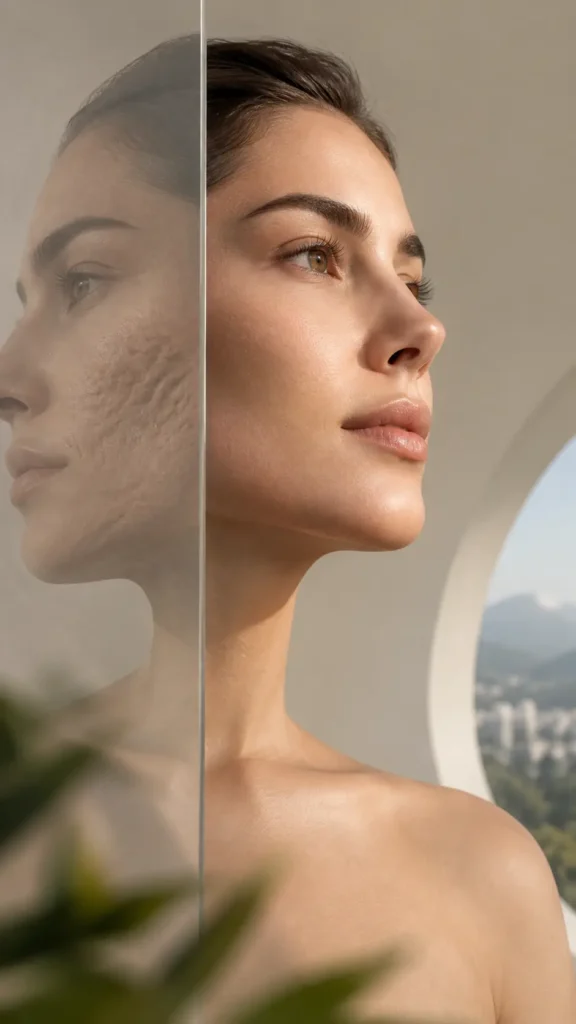
Fotona can be used in certain cases of atrophic acne scarring, particularly where there are depressions, texture changes or visible irregularities in the surface of the skin.
ATROPHIC SCARS
These sit below the level of the surrounding skin. Laser resurfacing can work gradually on the relief and support a more even appearance.
SCARS WITH UNEVEN TEXTURE
When a scar creates a perceptible difference in texture or surface, the treatment can be aimed at softening those irregularities through controlled renewal.
SCARS AFTER INJURIES OR PROCEDURES
Some scars left by trauma or procedures can be assessed for laser treatment. How old they are, their depth, their location and how they have evolved are all important in deciding the approach.
Who Is a Candidate for Fotona for Scars?
Scar treatment with Fotona can be considered for patients who want to improve texture irregularities or certain scars, but whether it is indicated has to be established after a medical assessment.
- People with atrophic scars: patients with depressed scars or changes in relief can be assessed to establish whether resurfacing can be part of their treatment.
- Patients with acne scars: Fotona can be considered in certain cases, particularly where there are texture changes or irregularities in the surface of the skin.
- People with uneven texture: it can also be assessed when the main concern is an uneven skin surface associated with previous scarring.
- Patients with realistic expectations: the goal is to improve how the scar looks, not to expect it to disappear. The assessment is where we establish what changes are reasonable in your case.
Book Your Assessment for Fotona for Scars in Medellín
If you have acne scars, texture irregularities or marks you want to improve, the first step is identifying what kind of scar you have and which options suit your skin.
At Clínica Be Dharma we can assess your case and tell you what is realistic — including when the answer is that laser is not the right tool for it.
Director médico

Dr. David Delgado
Cirujano Plástico
Experiencia médica a tu servicio
Médico cirujano de la Universidad Industrial de Santander, y Cirujano Plástico Maxilofacial y de la mano de la Universidad de Antioquia. Más de 15 años de experiencia.
Fotona for Scars Specialists in Medellín
At Be Dharma we treat scarring with technology, precision and a personalized medical approach. Our Fotona for scars protocol in Medellín is built from the diagnosis of your scar rather than from a standard course of sessions.
Book Your Appointment Here
Fill out the form and we will get back to you. If you are coming in for a facial procedure, your consultation includes a specialized facial diagnosis; for a body procedure, we run an InBody assessment so the treatment can be tailored to you.
Questions?
Frequently Asked Questions About Fotona for Scars
Does Fotona remove scars completely?
No. The goal of Fotona for scars is to gradually improve characteristics such as texture, relief and the general appearance of certain scars. How much improvement is possible depends on the type of scar, its depth, how old it is and how your skin responds.
Does Fotona work for acne scars?
Yes, Fotona can be part of the treatment for some acne scars, particularly atrophic scars, depressions or texture irregularities. Whether it is indicated has to be defined after assessing what kind of scarring you have.
Which types of scars can be treated with Fotona laser?
It can be assessed for atrophic scars, certain acne scars and marks that create irregularities in the surface of the skin. Not all scars respond the same way to laser, so the type, depth and characteristics have to be established first.
Does Fotona work for deep scars?
It can contribute to the treatment of some deep scars, but these usually need a more detailed evaluation. Scars such as ice pick scars or very marked depressions may need other techniques, or a combined protocol alongside the laser.
How many sessions are needed?
There is no single number that applies to every patient. It depends on the depth and extent of the scarring, the characteristics of your skin, the protocol used and how things progress after each session.
Does Fotona laser for scars hurt?
The sensation varies with the intensity of the treatment, the area and individual sensitivity. Some patients feel heat, stinging or temporary discomfort. During the assessment we explain what to expect for your protocol.
How long does the skin take to recover after Fotona resurfacing?
It depends on the depth and intensity of the laser resurfacing performed. Redness, tenderness or flaking can appear temporarily while the skin renews. The aftercare instructions are adjusted to the protocol you had.