Clínica Be Dharma
Aesthetic Clinic
Torre Médica Oviedo, 7th Floor, Office 776
Calle 6 Sur #43A-227, Medellín, Colombia
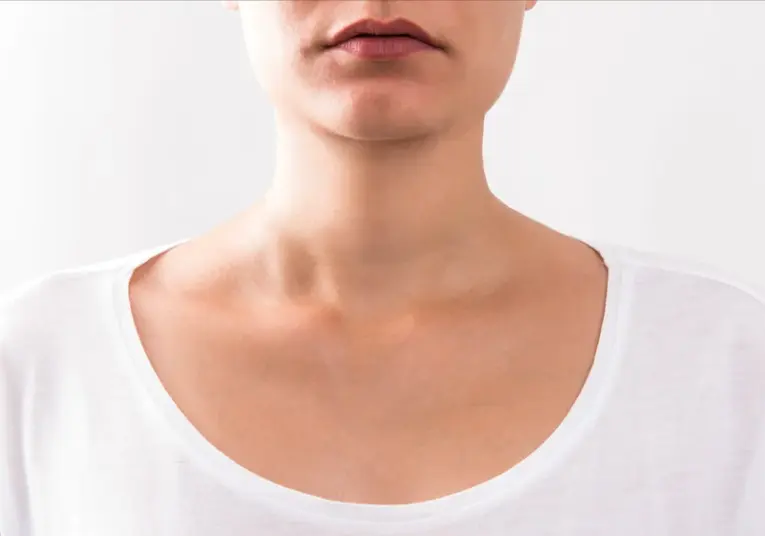
You may feel confident about your face yet notice that your neck tells a different story. Loose skin, horizontal lines, a crepey texture, or a softer jawline can make this area appear older than the rest of your features. At Clínica Be Dharma, we approach a neck lift non-surgical as a personalized plan rather than a single procedure, combining medical expertise and advanced technologies to improve firmness, skin quality, and definition while preserving a natural appearance.
The right non-surgical neck tightening treatment depends on what is causing the change. Some patients need loose neck skin treatment, while others are more concerned about submental fat, collagen loss, wrinkles, or reduced definition between the jaw and neck. For this reason, neck rejuvenation without surgery may involve several sessions or a carefully selected combination of treatments. There is no universal sagging neck skin treatment; the most effective approach begins with understanding your anatomy, skin quality, and personal goals.
Can Loose Neck Skin Really Improve Without Surgery?
Yes, mild to moderate neck laxity can improve without surgery, especially when the treatment is selected according to the cause of the concern. Non-surgical procedures may help the skin look firmer, smoother, and better defined; however, we always set realistic expectations: these treatments create gradual, more subtle changes and do not remove significant excess skin or reproduce the structural results of cervicoplasty. Research on ultrasound and radiofrequency supports improvements in neck laxity and wrinkles, although outcomes are generally more modest than those achieved with plastic surgery.
Why Does the Neck Lose Firmness So Quickly?
The neck has delicate skin and is constantly exposed to movement and environmental factors. Over time, collagen and elastin become less abundant and less organized, while repeated sun exposure can accelerate visible changes in texture, elasticity, and firmness. Genetics, weight fluctuations, and changes in deeper tissues also influence how early these signs appear.
Several factors may be involved at the same time:
- Collagen and elastin loss: the skin becomes less resilient and may begin to look thinner or crepey.
- Sun exposure: ultraviolet radiation contributes to collagen damage.
- Weight changes: gaining or losing weight can affect both skin laxity and the volume beneath it.
- Genetics: some patients naturally develop neck lines or reduce elasticity earlier.
- Repeated movement: turning, bending, and looking down may make horizontal lines more noticeable.
- Reduced jawline definition: changes in the lower face can soften the transition between the chin and neck.
- Submental fat: fullness beneath the chin can make the neck appear heavier or less defined.
For this reason, an effective aging neck treatment must be considered more than the skin’s surface. A patient searching for a crepey neck skin treatment may need a different approach from someone whose main concern is fat or deeper neck laxity.
What Can a Non-Surgical Neck Lift Actually Improve?
A non-invasive neck lift is most useful when the changes are still mild or moderate. Depending on the technology selected, it may support collagen remodeling, improve skin quality, and create a more defined appearance over time.
| Main Concern | What Treatment May Improve | Important Limitation |
|---|---|---|
| Mild or moderate laxity | Greater firmness and a smoother appearance | It cannot remove a large amount of excess skin |
| Fine or horizontal lines | Softer-looking wrinkles and improved texture | Deep folds may remain visible |
| Crepey or uneven skin | Better skin quality and collagen support | Results develop gradually |
| Soft jawline definition | A clearer transition between the jaw and neck | Structural changes may need a different approach |
| Early signs of aging | Progressive rejuvenation without major surgery | Maintenance sessions may be recommended |
We consider neck skin tightening and neck wrinkles treatment part of a progressive rejuvenation process. Among the available neck lift alternatives, some act more superficially on skin quality, while others deliver energy at deeper levels. None should be presented as an exact substitute for surgery when there is advanced laxity, prominent muscular banding, or considerable excess skin.
A medical assessment is essential because the same outward concern can come from very different structures. At Clínica Be Dharma, we evaluate whether the main issue is skin laxity, submental fat, visible platysma bands, altered texture, reduced jawline definition, or a combination of these factors. Understanding the anatomy behind the concern allows us to select a treatment that addresses the right tissue instead of applying the same protocol to every neck.
Which Treatments Can Tighten Your Neck Without Surgery?
At Clínica Be Dharma, we do not begin by choosing a device. We first identify whether the visible change comes mainly from skin laxity, collagen loss, fine wrinkles, submental fat, or reduced jawline definition. This distinction helps us select the most appropriate option for neck tightening without surgery.
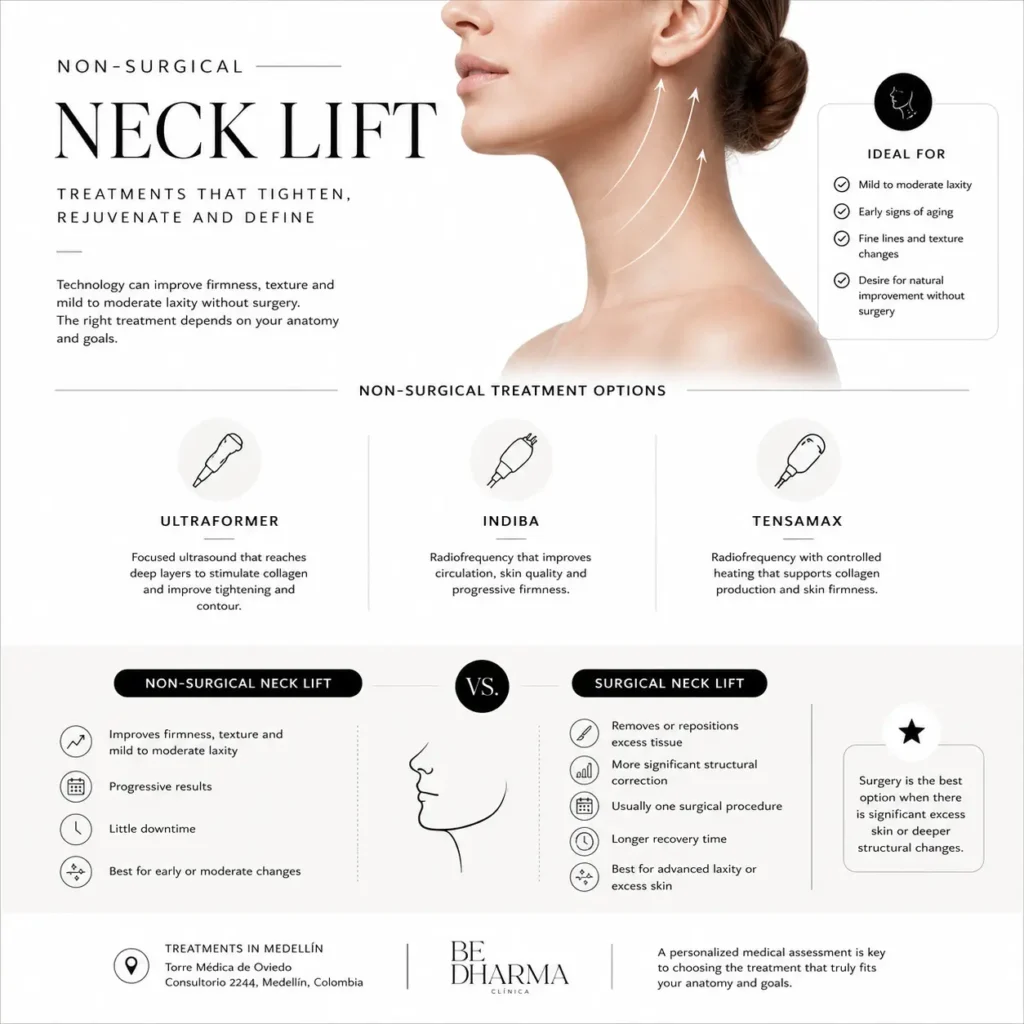
Ultraformer: HIFU for Deeper Neck Tightening
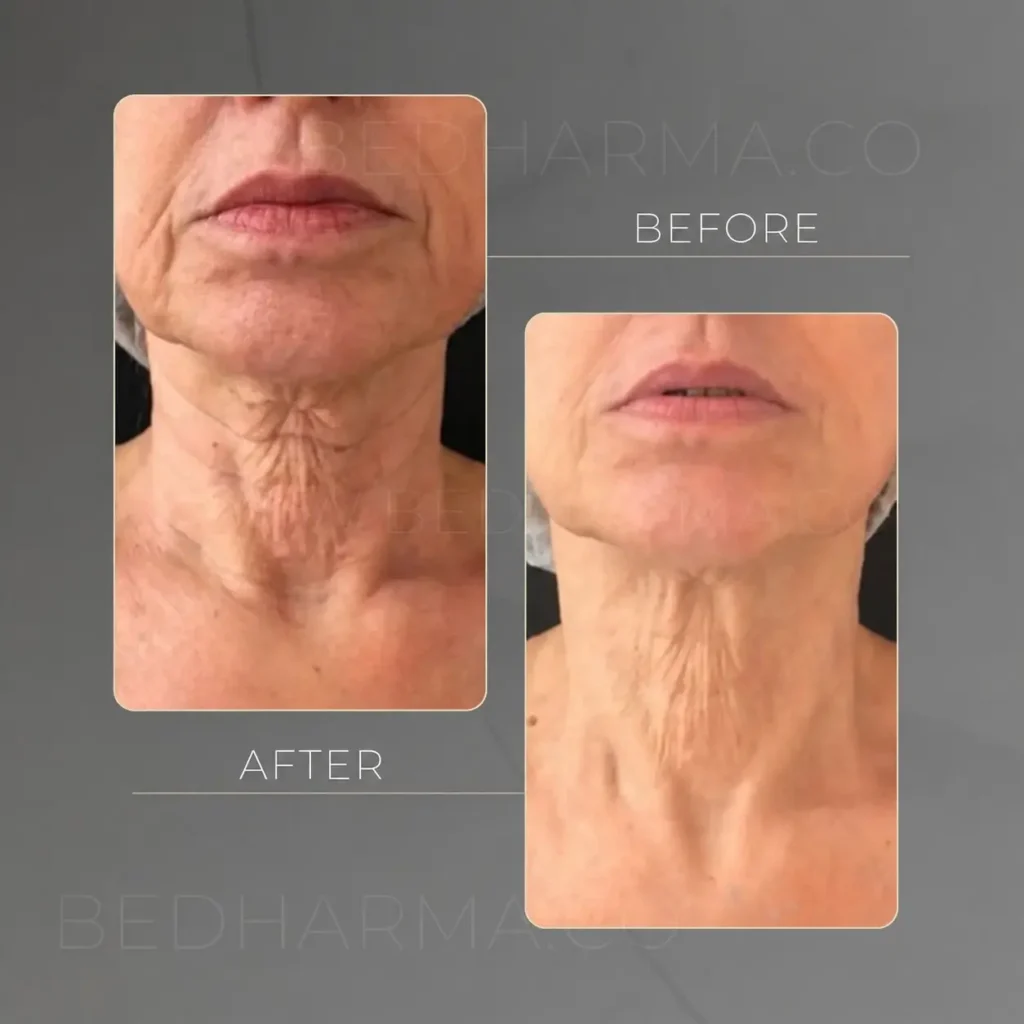
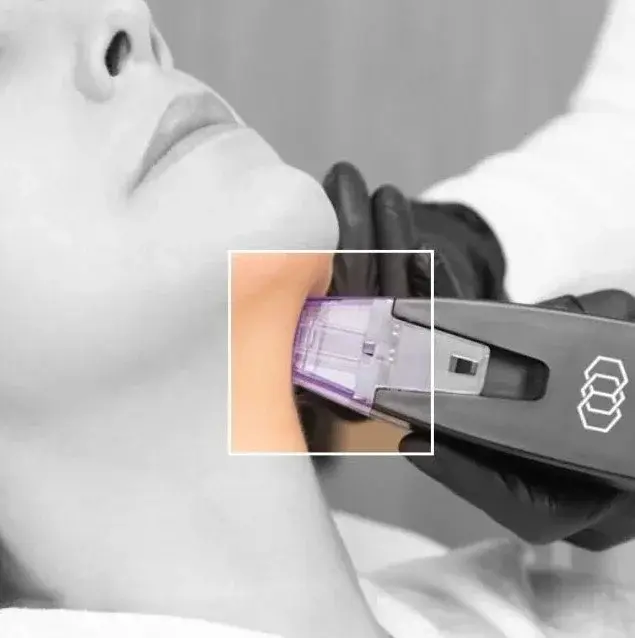
Ultraformer delivers focused ultrasound energy at selected tissue depths without making incisions. This controlled energy initiates a remodeling response in the treated tissues, encouraging new collagen formation over time. Research evaluating HIFU for facial and neck rejuvenation supports its use for non-invasive skin tightening, particularly in patients with mild or moderate laxity.
An Ultraformer neck lift may be considered when the goal is to:
- Improve mild or moderate skin laxity.
- Create a firmer-looking neck.
- Enhance the transition between the jawline and neck.
- Obtain progressive improvement without surgical incisions.
A HIFU neck lift does not remove excess skin. Instead, ultrasound neck tightening relies on the body’s gradual collagen response, so the final change is generally more subtle and progressive than a surgical lift.
INDIBA: A Gentle Option for Skin Quality and Firmness
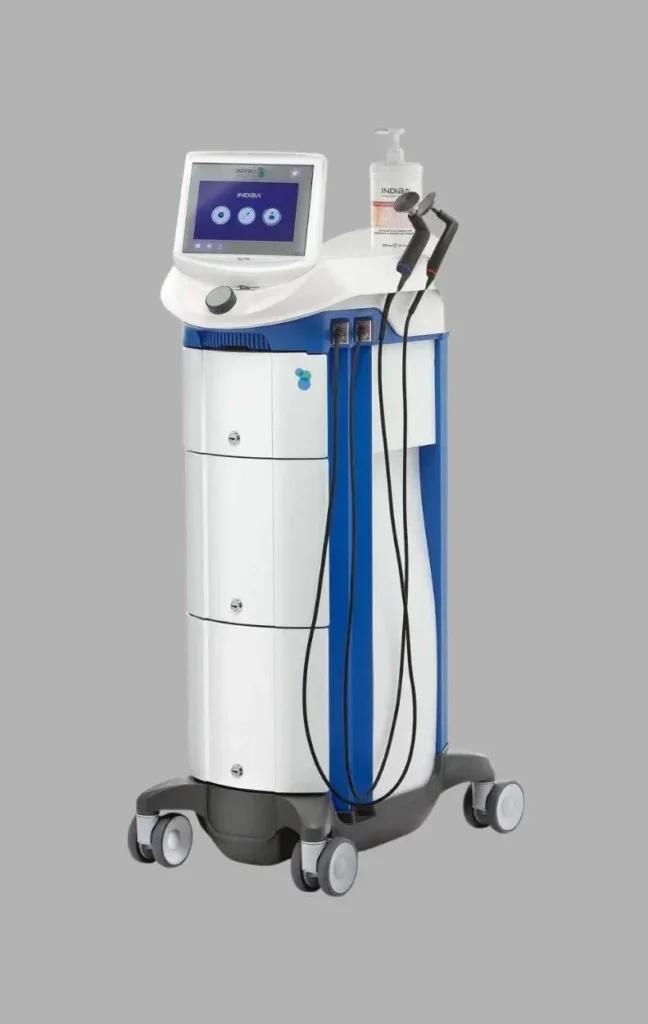
INDIBA uses non-ablative radiofrequency to deliver controlled energy without puncturing the skin. We may incorporate an INDIBA neck treatment when the priorities include skin quality, hydration, circulation, elasticity, and gradual collagen support. The manufacturer describes its aesthetic application as a non-invasive option for skin tightening and facial rejuvenation.
This treatment is often better understood as part of a process rather than a dramatic one-session lift. It may be included in a multi-session plan or combined with another technology when the patient wants neck rejuvenation without surgery with a gentle and progressive approach.
INDIBA may be especially useful when we want to focus on:
- Early loss of firmness.
- Dehydrated or dull-looking skin.
- Fine textural changes.
- Progressive collagen stimulations for the neck.
- Maintenance after another tightening procedure.
Tensamax: Radiofrequency for Loose and Sagging Skin
Tensamax applies radiofrequency energy to generate controlled heating within the treated tissues. This thermal response is intended to support collagen activity and improve the sensation of firmness without surgical incisions. The technology forms part of Clínica Be Dharma’s portfolio for treating skin laxity.
We may consider radiofrequency neck tightening for patients with early or moderate laxity who prefer gradual improvement. As with other forms of RF neck tightening, the response depends on the condition of the skin and the treatment parameters selected.
| Treatment | Main Focus | Type of Procedure |
|---|---|---|
| Ultraformer | Deeper tightening and contour support | Non-invasive focused ultrasound |
| INDIBA | Skin quality, revitalization and progressive firmness | Non-invasive radiofrequency |
| Tensamax | Controlled heating for firmness and collagen support | Non-invasive radiofrequency |
No technology should be described as the universal solution for every sagging neck skin treatment. A patient with thin, crepey skin may require a different plan from someone whose main concern is deeper laxity or fullness beneath the chin.
Why One Session May Not Be Enough
The effects of non-surgical procedures are linked to a biological process. Collagen does not fully renew immediately after energy is delivered; remodeling develops gradually and may continue after the appointment. This is why non-surgical neck lift results are usually assessed over time rather than the following day.
When patients ask us how many sessions are needed for neck tightening, our answer depends on the treatment, the degree of laxity, previous procedures, age, skin quality, and individual response. A plan may include:
- An initial series of sessions when the selected technology works cumulatively.
- Medical reassessment to document how the tissues are responding.
- Combination treatments when different layers or concerns need to be addressed.
- Maintenance sessions when appropriate to preserve skin quality.
There is also no single answer to how long a non-surgical neck lift lasts. Results vary with the technology, natural aging, sun exposure, weight changes, skincare habits, and the patient’s ability to produce new collagen.
What If Your Neck Needs More Than Surface-Level Tightening?
Some concerns require more than external heating or focused ultrasound. When we identify pronounced textural changes, deeper laxity, localized fat, or a need for more intensive collagen remodeling, we may discuss minimally invasive options.
Morpheus8 for Neck Texture and Skin Laxity
Morpheus8 combines microneedles with fractional radiofrequency. The needles enter the skin at controlled depths and deliver RF energy within the tissue, making this a minimally invasive procedure, not a superficial or completely non-invasive radiofrequency treatment. InMode describes Morpheus8 as fractional radiofrequency technology designed for multi-level soft-tissue treatment, while clinical reviews associate RF microneedling with progressive dermal remodeling and neocollagenesis.
An RF microneedling neck protocol may be considered for:
- Crepey or irregular texture.
- Fine neck wrinkles.
- Mild or moderate skin laxity.
- Thin-looking or photoaged skin.
- Patients who need more intensive collagen stimulation.
FaceTite When Skin Laxity and Fat Appear Together
FaceTite belongs in a different category from Ultraformer, INDIBA, and Tensamax. It is a minimally invasive neck lift option that works beneath the skin through a small access point, using radiofrequency-assisted technology to address deeper tissue.
We may evaluate a FaceTite neck lift when the patient presents a combination of:
- More noticeable skin laxity.
- Localized submental fat.
- Reduced jawline definition.
- A need for deeper tissue contraction.
- Concerns that are unlikely to improve sufficiently with external treatments alone.
Because it works internally, FaceTite may offer a more intensive approach to double chin and neck tightening than a fully non-invasive treatment. However, it still involves an invasive component, medical preparation, anesthesia or sedation planning, and a recovery process. It should never be described as a simple facial or a zero-downtime procedure. Clínica Be Dharma includes FaceTite among its technologies for facial remodeling and laxity.

When a Non-Surgical Neck Lift Is No Longer Enough
Non-surgical technologies can create meaningful improvements in selected patients, but they cannot correct every degree of neck aging. When there is advanced laxity or a significant amount of excess skin, continuing to add non-invasive sessions may not produce the structural change the patient expects.
Surgical vs Non-Surgical Neck Lift: What Is the Difference?
The key difference is not only recovery time. Non-surgical treatments are designed to improve firmness, texture, and mild-to-moderate laxity, while surgery can reposition deeper structures and remove excess skin. A minimally invasive option does not reproduce the same structural outcome as a surgical neck lift.
When May Cervicoplasty Be the Better Option?
Cervicoplasty may be more appropriate when the concern involves deeper tissues that external energy-based treatments cannot fully reposition or remove.
It may be a better option when there is:
- A significant amount of excess skin
- Advanced or hanging neck laxity
- Prominent platysma bands
- Deeper tissue descent
- Fat that requires surgical contouring
- Expectations for a more visible structural transformation
What surgery can address:
- Reposition deeper tissues
- Tighten the platysma muscle
- Redrape the skin
- Remove excess tissue
Choosing surgery does not mean non-surgical technology has failed. It means the concern is located in tissues that may require a deeper level of correction.
Traveling to Medellín for a Surgical Neck Lift
For international patients, the process can begin before purchasing a flight. At Clínica Be Dharma, the first step is gathering the information needed for an initial plastic surgery assessment and determining whether an in-person evaluation in Medellín is reasonable.
- Send clear photographs of the face, jawline, neck, and profile.
- Share your medical history, previous procedures, medications, allergies, and relevant health conditions.
- Attend a virtual consultation to discuss your concerns and possible options.
- Receive guidance about any preoperative tests that may be required.
- Plan the trip only after medical orientation, including arrival, accommodation, and recovery time in Medellín.
- Complete an in-person examination to confirm candidacy and define the surgical plan.
- Remain in the city for the required postoperative checks.
- Continue follow-up after returning home, with guidance on care and future controls.
Why Choose Clínica Be Dharma for Neck Tightening in Medellín?
At Clínica Be Dharma, we understand that neck aging does not look the same in every patient. That is why we never begin with a standard protocol. We first evaluate skin thickness and quality, the degree of laxity, submental fat, jawline definition, wrinkles, texture, medical history, and the result you hope to achieve. This allows us to determine whether your plan should include focused ultrasound, radiofrequency, RF microneedling, biostimulation, a minimally invasive procedure, or an assessment with a plastic surgeon. By offering technologies such as Ultraformer, INDIBA, Tensamax, Morpheus8, and FaceTite, we can approach different layers and causes of neck aging within the same medical setting.
If you arrived here looking for a non-surgical neck lift in Medellín, our goal is to help you understand what your neck truly needs—not to place you into a one-size-fits-all treatment. From your initial assessment to the procedure and follow-up sessions, our medical team accompanies you through each stage with clear guidance and realistic expectations. We are in Torre Médica Oviedo, a premium and easily accessible medical location in Medellín, where you can receive a personalized neck tightening treatment designed around your anatomy, skin quality, and goals.
Frequently Asked Questions About Non-Surgical Neck Lifting
What Is the Best Non-Surgical Neck Lift Treatment?
There is no single treatment that is best for every patient. The most appropriate non-surgical neck lift treatment depends on whether the main concern is loose skin, fine wrinkles, submental fat, reduced jawline definition, or changes in skin texture. At Clínica Be Dharma, we evaluate the neck before recommending Ultraformer, INDIBA, Tensamax, Morpheus8, biostimulators, FaceTite, or a combination of treatments.
Can Loose Neck Skin Really Be Tightened Without Surgery?
Mild or moderate laxity may improve through technologies that support collagen remodeling and skin firmness. A loose neck skin treatment can make the area appear smoother, firmer, and better defined, but it cannot remove a significant amount of excess skin. When laxity is advanced, a surgical assessment may provide more realistic options.
How Does a Neck Lift Non-Surgical Treatment Work?
A neck lift non-surgical plan may use focused ultrasound, radiofrequency, RF microneedling, or collagen biostimulation. These treatments work through different mechanisms, but most aim to activate a gradual tissue response and support new collagen production. The selected technology and treatment depth depend on the patient’s anatomy and the concern being addressed.
How Many Sessions Are Needed for Neck Tightening?
The number of sessions varies according to the technology, the condition of the skin, and the response of each patient. Some treatments may be performed in a limited number of sessions, while INDIBA, Tensamax, and other progressive protocols may require a series of appointments. We may also recommend reassessment or maintenance sessions after observing how the tissues respond.
How Long Do Non-Surgical Neck Lift Results Last?
There is no universal duration. Non-surgical neck lift results depend on the treatment selected, age, skin quality, collagen response, sun exposure, weight changes, lifestyle, and maintenance. These procedures do not stop the natural aging process, although an appropriate skincare routine and periodic treatments may help preserve the improvement.
Is Ultraformer Effective for Neck Tightening Without Surgery?
Ultraformer uses focused ultrasound to deliver energy at selected tissue depths and encourage progressive collagen remodeling. An Ultraformer neck lift may be appropriate for patients with mild or moderate laxity who want improved firmness and jawline definition without incisions. It does not remove considerable excess skin or reproduce the results of surgery.
What Is the Difference Between HIFU and Radiofrequency Neck Tightening?
A HIFU neck lift uses focused ultrasound to reach specific tissue depths, while radiofrequency neck tightening generates controlled heat through radiofrequency energy. Both may support collagen production, but they distribute energy differently and may be selected for different concerns. A medical evaluation helps us determine which technology is more suitable or whether they should be used at different stages of a combined plan.
Can INDIBA Improve Loose or Crepey Neck Skin?
An INDIBA neck treatment may support circulation, skin quality, hydration, and gradual firmness. It is often considered for early signs of aging, fine textural changes, or maintenance after another procedure. Because its effects are progressive, INDIBA is commonly incorporated into multi-session protocols rather than presented as an immediate lifting procedure.
Is Tensamax a Suitable Sagging Neck Skin Treatment?
Tensamax uses radiofrequency to create controlled heating in the treated tissues. This may support collagen activity and improve the appearance of mild or moderate laxity. As a sagging neck skin treatment, its results generally develop progressively and may require more than one session, depending on the patient’s skin quality and goals.
Is Morpheus8 Suitable for the Neck?
Yes, Morpheus8 may be used on the neck in appropriately selected patients. It combines microneedling with fractional radiofrequency to address fine wrinkles, irregular texture, crepey skin, and laxity. Because the needles enter the skin, a Morpheus8 neck treatment is considered minimally invasive rather than completely non-invasive.
Does Morpheus8 Remove Excess Neck Skin?
Morpheus8 may improve firmness and texture by stimulating tissue remodeling, but it does not surgically remove excess skin. Morpheus8 for loose neck skin is generally more appropriate when laxity is mild or moderate. Patients with hanging skin or advanced structural changes may require an assessment for FaceTite or cervicoplasty.
Can Biostimulators Be Used for Neck Rejuvenation?
Selected biostimulators for the neck may be used to encourage collagen production and progressively improve skin quality. They should not be confused with conventional fillers used mainly to add volume. The product, dilution, injection plane, amount, and number of sessions must be individualized because the skin of the neck is thin and anatomically delicate.
Can Dermal Fillers Tighten the Neck?
Dermal fillers are not a universal solution for loose neck skin. In some patients, injectables may support surrounding structures or address specific lines, but they do not remove excess skin. For broader collagen stimulation for the neck, a medically selected biostimulator may be more appropriate than a traditional volumizing filler.
What Is the Difference Between FaceTite and a Non-Invasive Neck Lift?
FaceTite works beneath the skin through small access points and uses radiofrequency-assisted technology to address laxity and, when indicated, localized fat. For this reason, a FaceTite neck lift is minimally invasive. Ultraformer, INDIBA, and Tensamax are applied externally and do not require internal access.
Can FaceTite Help with a Double Chin and Loose Skin?
FaceTite may be considered when submental fat and skin laxity appear together. It can provide a deeper approach than external energy-based treatments, particularly when the jawline has lost definition. However, it involves medical preparation, an invasive component, and recovery, so candidacy must be confirmed during an in-person assessment.
Can Different Neck Tightening Treatments Be Combined?
Yes. A combined plan may be useful when different concerns are present in separate tissue layers. For example, Ultraformer may be paired with INDIBA, Tensamax may complement biostimulation, or Morpheus8 may be followed by maintenance technology. We determine the sequence and intervals carefully to avoid unnecessary treatment and allow the tissues to respond.
Is a Non-Surgical Neck Lift Painful?
Comfort levels vary according to the technology, treatment intensity, and individual sensitivity. Patients may notice warmth, pressure, tingling, or brief discomfort during certain procedures. Minimally invasive options such as Morpheus8 or FaceTite usually require additional comfort measures. Before treatment, we explain what sensations can be expected and how they will be managed.
References
- Uitto, J. (2008). The role of elastin and collagen in cutaneous aging: Intrinsic aging versus photoexposure. Journal of Drugs in Dermatology, 7(2 Suppl.), S12–S16.
- Shadfar, S., & Perkins, S. W. (2014). Anatomy and physiology of the aging neck. Facial Plastic Surgery Clinics of North America, 22(2), 161–170.
- Fabi, S. G. (2015). Noninvasive skin tightening: Focus on new ultrasound techniques. Clinical, Cosmetic and Investigational Dermatology, 8, 47–52.
- Ayatollahi, A., Gholami, J., Saberi, M., Hosseini, H., & Firooz, A. (2020). Systematic review and meta-analysis of safety and efficacy of high-intensity focused ultrasound for face and neck rejuvenation. Lasers in Medical Science, 35, 1007–1024.
- Weiner, S. F. (2019). Radiofrequency microneedling: Overview of technology, advantages, differences in devices, studies, and indications. Facial Plastic Surgery Clinics of North America, 27(3), 291–303
- Tan, M. G., Jo, C. E., Chapas, A., Khetarpal, S., & Dover, J. S. (2021). Radiofrequency microneedling: A comprehensive and critical review. Dermatologic Surgery, 47(6), 755–761.
- Yutskovskaya, Y. A., & Kogan, E. A. (2017). Improved neocollagenesis and skin mechanical properties after injection of diluted calcium hydroxylapatite in the neck and décolletage: A pilot study. Journal of Drugs in Dermatology, 16(1), 68–74.
Educational Information Notice
The information in this article is provided for educational purposes only and does not replace a medical diagnosis or personalized treatment plan. Every neck has different anatomical and skin characteristics, so a medical assessment is essential to determine which treatment, combination of technologies, or surgical evaluation may be appropriate for your needs and goals.